 If you have ever tried to pull real-world public data into a side project, you know the drill. You find a promising data source, spend an hour navigating a government portal, discover the documentation is from 2017, realise the endpoint you need requires a form submission and a three-day approval window, and eventually give up and hardcode some values to make the demo look good.
I have been through that loop more times than I would like to admit. So I built APIVine to solve it - for myself first, and hopefully for other developers too.
What is APIVine?
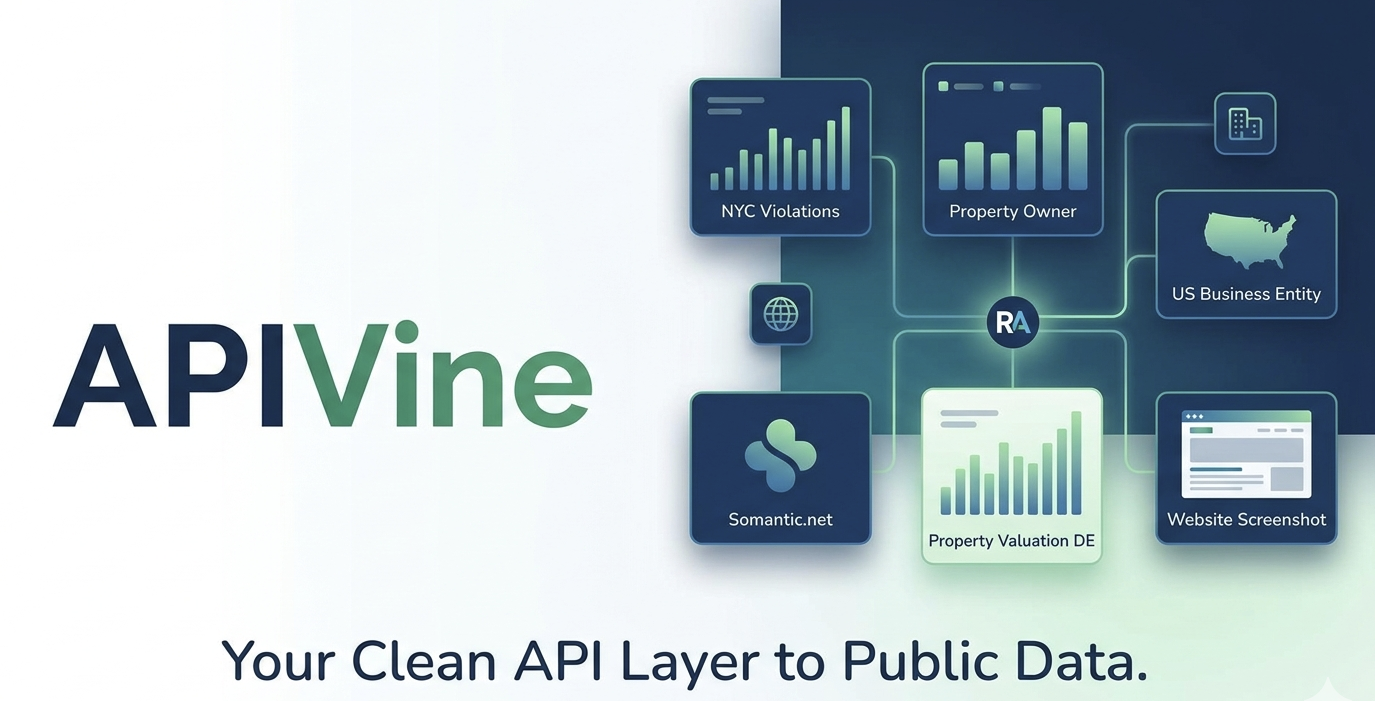
APIVine is a curated collection of reliable, well-documented APIs for accessing public data. Every API on the platform has a free tier, consistent JSON responses, and documentation that actually tells you what the parameters do. They are all available through RapidAPI, so you get a single dashboard, a single billing relationship, and a single API key to manage across all of them.
The idea is simple: I do the hard work of finding, normalising, and hosting the data so you do not have to.
The APIs available right now
NYC Property Violations API
This one started the whole project. I was building a tool to screen NYC rental properties before signing leases - checking for open violations, complaints, and permits. The data is all technically public (NYC Open Data, DOB BIS, HPD), but stitching it together is genuinely painful. The NYC Property Violations API wraps it all into a single, clean interface.
You can look up a property by address or BBL (Borough-Block-Lot), get all DOB and HPD violations, complaints, permits, and even query for changes since a specific date - which is useful if you are polling for alerts. There is also a landlord lookup endpoint that shows you every property associated with a given owner, and a neighbourhood statistics endpoint for market-level context.
const response = await fetch(
  'https://new-york-city-violation-alerts.p.rapidapi.com/lookup?address=123+Main+St+Brooklyn+NY',
  {
    headers: {
      'X-RapidAPI-Key': 'YOUR_KEY',
      'X-RapidAPI-Host': 'new-york-city-violation-alerts.p.rapidapi.com'
    }
  }
)
National Property Owner Lookup API
Knowing who owns a property is surprisingly difficult to find out programmatically. This API gives you owner name, mailing address, and portfolio data across multiple counties - currently covering New York City, Philadelphia, Washington DC, and Boston, with more being added.
It also supports a portfolio endpoint: give it an owner name and get back all the properties they own in the dataset. Useful for due diligence, investment research, or any application where you need to understand ownership at scale.
US Business Entity Lookup API
Secretary of State business registries are some of the most useful and most annoying data sources in existence. Every state has one, most have a search UI, and almost none have an API. This endpoint lets you search for registered business entities by name or ID across multiple US states and get back structured data: entity name, status, registered agent, formation date, and more.
Somantic.net API
This one is a GraphQL API for German real estate listings, aggregated from all the major German property platforms - Immobilienscout24, Immowelt, Immonet, Kleinanzeigen, and several others. Query listings by city, ZIP code, or federal state; get average prices per square metre; filter by for-sale vs. for-rent. It powers somantic.net, where you can also explore the data through a web UI.
Property Valuation Germany API
An automated valuation model for German residential properties. Post an address and property attributes, get back an estimated value. Useful for quick sanity checks on listing prices, or for building tools that need ballpark valuations without a full appraisal.
Website Screenshot API
The odd one out in this list, but one of the most frequently requested: a dead-simple endpoint that takes a URL and returns a full-page screenshot rendered by headless Chromium. One GET request, one PNG back. No spinning up Playwright, no managing browser instances, no dealing with timeouts.
Why RapidAPI?
I get asked this occasionally. The honest answer is that RapidAPI handles everything I do not want to deal with: authentication, rate limiting, billing, usage analytics, and discovery. I can focus on building and maintaining the APIs themselves, and developers get a familiar interface they have probably already used.
The free tiers are genuine - not crippled demo modes. You can build and test a real integration without entering a credit card, which matters when you are evaluating whether a data source fits your use case.
What is coming next
The roadmap is driven by what people actually request. The contact form on the site goes directly to my inbox, and I read every message. A few things already in progress:
- Expanding the National Property Owner Lookup to more counties and states
- Adding more US states to the Business Entity API
- A property timeline endpoint for NYC that shows the complete history of permits, violations, and complaints for a given address in chronological order
If there is a public dataset you have been wishing someone would turn into a clean API, let me know. The whole point of this project is to make data that is technically public actually accessible.
Getting started
- Go to apivine.com and browse the available APIs
- Click through to any API and hit Get API on RapidAPI
- Subscribe to the free tier - no credit card required
- Copy the example code from the documentation and start building
No approval process, no waiting, no government portal.
I built APIVine as part of Kretronik. If you have questions or want to talk through a use case, reach me at viktor.kreschenski@kretronik.com.
Tags: side-project api public-data developer-tools nyc real-estate